Examples / AI
Where does a human fit in an AI review loop?
Updated
User -> Agent -> LLM -> Guardrail -> |Accepted, Review| on one line, Review -> Human Reviewer -> Agent on the next. The bars make the guardrail a choice: each pass the output goes to Accepted or to Review, and the passes take turns. The second line extends the Review branch out to a person and then sends the verdict back to the agent, four hops in reverse, as a separate flow that plays once the first has finished.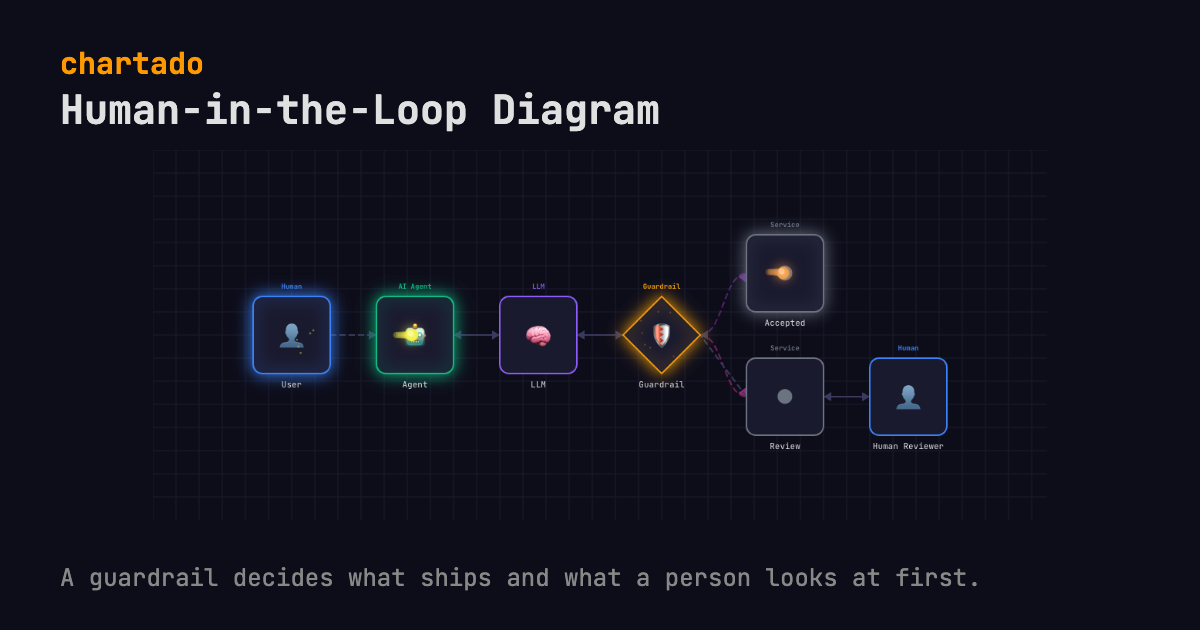
THE TEXT THAT DRAWS IT
User -> Agent -> LLM -> Guardrail -> |Accepted, Review|
Review -> Human Reviewer -> Agent
Edit it in the box above and the diagram redraws as you type. Export it as an animated GIF, WebM, WebP or MP4 video, or a still PNG or PDF, every format free. WebM and PNG export here; the rest are in the app after a free sign-up. Every format embeds this text, so the file can be read back into the editor.
WHAT IT SHOWS
Most of what the LLM produces should go straight out. Some of it should not, and something has to decide which.
That is the Guardrail box. Every output passes through it, and the bars after it mean each output goes one way: Accepted, or Review. Not both. Passes take the branches in turn, Accepted on one pass and Review on the next, so both paths get shown (the real ratio is whatever your threshold makes it, and it should be nowhere near half).
The second line is the part I care about. Review -> Human Reviewer -> Agent extends the Review branch out to a person and then points back at the Agent, which sits four columns to the left. No long arrow gets drawn for that. It retraces the forward route in reverse, Human Reviewer to Review to Guardrail to LLM to Agent, as a second flow that starts half a second after the first one has finished, so you watch the verdict travel back through every box it passed going out.
Compare that with a line that stops at the reviewer. Ending there gives you an audit trail: a person saw it and nothing changed. The correction only exists if the verdict goes back to the agent, and then the next attempt starts from it. Without the last hop the second line would end at the reviewer and there would be no return flow at all, just one flow with a longer Review branch.
In this design the user never sees anything the guardrail rejected. The reviewer’s correction goes to the agent, and the agent has another go before anything reaches the user.
QUESTIONS
- What does the Guardrail box represent?
- Whatever check sits between the model and the outside world. A moderation model, a rules filter, a confidence threshold, a schema check, or two of those in a row. It draws as one box because from the outside it is one decision, accept or send to a person, and the word Guardrail gets it its own icon.
- Why does the reviewer feed back to the agent rather than the user?
- Because the review is there to change what the agent does next, and a correction that goes straight to the user changes nothing. Drawn this way the user only ever sees accepted output, and the reviewer sits inside the loop.
MORE AI PATTERNS
RAG pipeline diagram
The question reaches the vector database before the model is called, and the animation shows it.
User -> Query Agent -> Vector DB -> LLM -> User
Multi-agent router diagram
A router agent in front of three specialist agents, drawn in one column so nobody reads them as a pipeline.
User -> Router Agent -> {Research Agent, Code Agent, Analysis Agent}
ReAct tool-calling diagram
Each turn the model calls a tool or answers, and a tool result goes back to the agent for another turn.
User -> Agent -> LLM -> |Tool, Response|
MCP architecture diagram
The agent talks to its MCP client and nothing else; the tools sit behind the server.
Agent -> MCP Client -> MCP Server -> |Knowledge Base, Code Sandbox, Memory|
Also on this site: Serverless REST API diagram, Pub/sub fan-out diagram, Queue worker diagram, Event pipeline diagram and Cloudflare Workers diagram. See all 10 patterns.
Chartado is a text-to-diagram tool: you type lines like A -> B, it draws the architecture and animates the flow.